Local AI, honestly · Mac · iPhone · iPad
A real assistant. All on your own devices.
Mira is a finished app for Mac, iPhone, and iPad. It runs the models on your own hardware and syncs over your iCloud, so there's nothing to wire up and nothing leaves your devices. The others are servers you bolt onto your tools; this one you just open.
Applied AI, no hype. Built in the open with Claude Code.
What you can do
One app, most of your day.
Not a toolkit to assemble; an assistant that already does the things you'd actually ask for.
Chat with your codebase
Open a project folder and ask questions about structure, logic, or specific files.
Summarize any document
Drop in a PDF, an article, a note; Mira reads it locally and nothing leaves the device.
Switch models on the fly
Qwen3.6, Gemma4, Llama, and more; models sized to fit any Apple Silicon Mac.
Search the web with context
Opt-in grounded answers when you need current information.
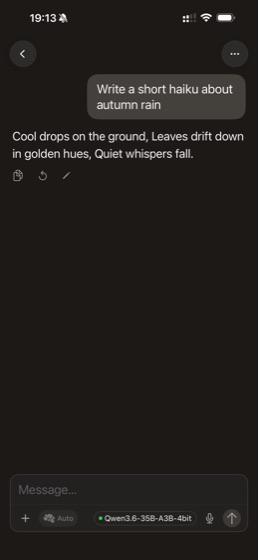
Pick up on your iPhone
Conversations sync to your iPhone via iCloud; start on Mac, continue on the go.
Run without internet
Full inference offline, zero API keys, no metered costs.
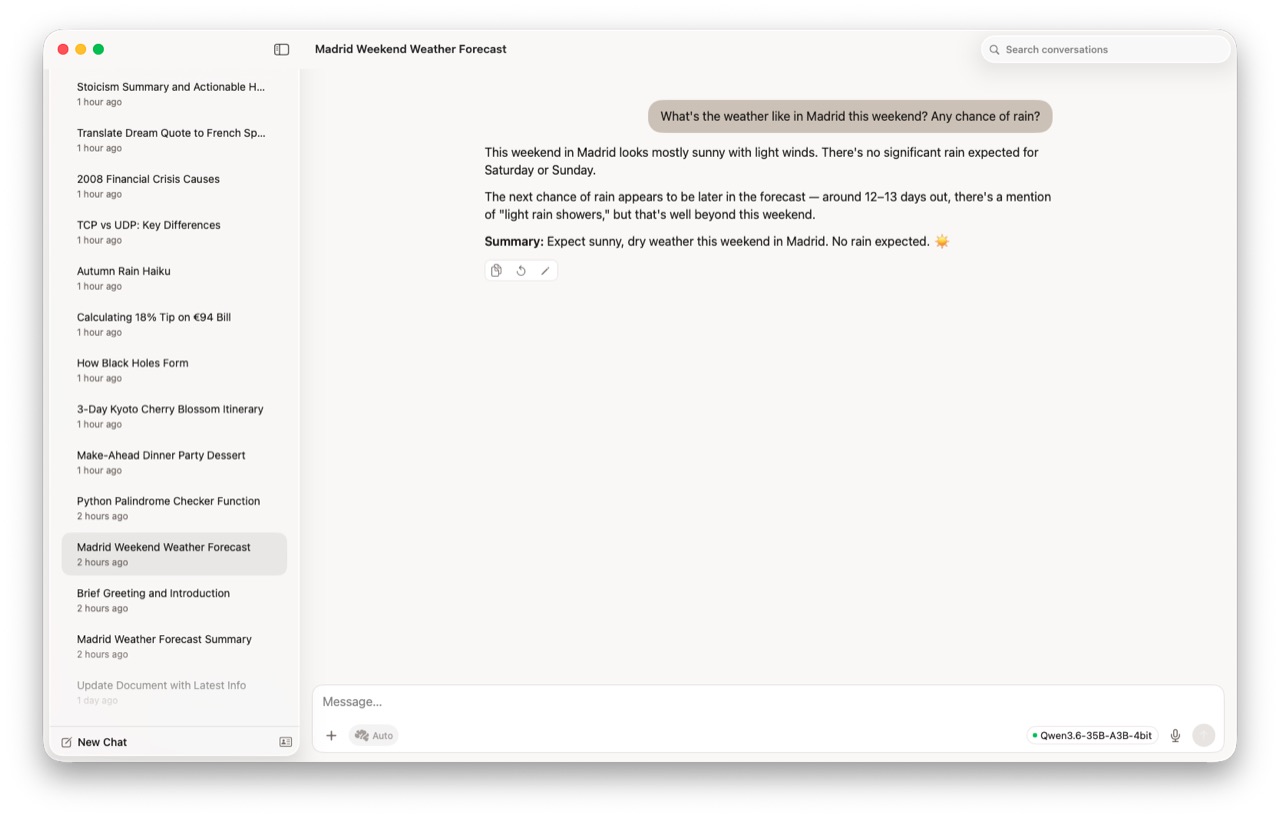
See it running
The same Mira, on every screen.
Short, elegant conversation
What runs on your Mac
Local AI is a memory game.
The bigger the model, the more RAM it eats. So forget leaderboards. Here's what fits on your Mac, and how it feels to use.
Unified memory · model that fits · how it feels
Measured, not marketed: 35B at 4-bit on an M5 MacBook Pro, 32 GB, June 2026. · Full numbers ↗
Under the hood
Honest architecture.
Local inference
Powered by Apple Silicon. Run Qwen3.6, Gemma4, Llama, and other open models fully offline; zero API keys, no metered costs. Works on any M-series Mac with 16 GB or more.
No cloud
Your conversations stay on your Apple devices. Sync between Mac and iPhone uses your personal iCloud; no Mira servers, no third-party data handling, ever.
macOS + iOS + iPadOS
Native SwiftUI apps sharing one backend. The Mac runs the model; your iPhone and iPad connect over your home network for a seamless multi-screen experience.
mira-apps on GitHubOpen source
The inference backend (mira-core) is MIT licensed; inspect it, modify it, self-host it. You can read exactly what runs on your machine.
mira-core on GitHubAbout
Learning by building.
It started with a let-down. I downloaded a small model, ran it locally, and asked it to rate my Mac for running AI. It had nothing; its training stopped in April 2024. So on its own the model was close to useless, and I could see how much I still didn't know. I opened Claude Code and asked, more or less: what do I do with this?
The answer was tools. My first web search worked and then immediately didn't: it kept handing me link names and privacy policies instead of the actual pages. Another letdown. So I asked for a fetch function to go read them, and that one stuck. It works now. Suddenly I could ask almost anything, all on my own hardware, and I felt two things at once: how little I still knew, and how good it was to take one more step anyway. Back then I called it OllamaSearch because of its limited scope (I didn't even know how long it would take to wire a tool), just a non-engineer learning to work with Claude. To me a viewport is still a window and a pill is a button. But I know how to tell Claude what to fix, and that turns out to be most of it. I had no idea about AI when I started. I'm getting somewhere now.
“AI is here, and it's useful. But you still need to know what it's good for; it won't replace your judgment. Do your own research.”